
We add FAQ sections to OpenCart 3 categories and generate automatic schema.org FAQPage JSON-LD to improve your chances for FAQ rich snippets in Google. Paid mod…
FAQPage JSON-LD (schema.org) and support for rich snippets in Google.
The code and module are not available for free download – we implement it for you.
How to add convenient FAQ sections to your OpenCart 3 categories, “describe” them with schema.org and FAQPage JSON-LD, and increase your chances for FAQ rich snippets in Google – without exposing the paid module itself or its code.
⚠ This guide explains the concept and benefits – it does not provide the full code. The actual solution is a paid module which we implement (licensed for your store). This protects both your and our investment – price for integration in OpenCart – 25 Euro.
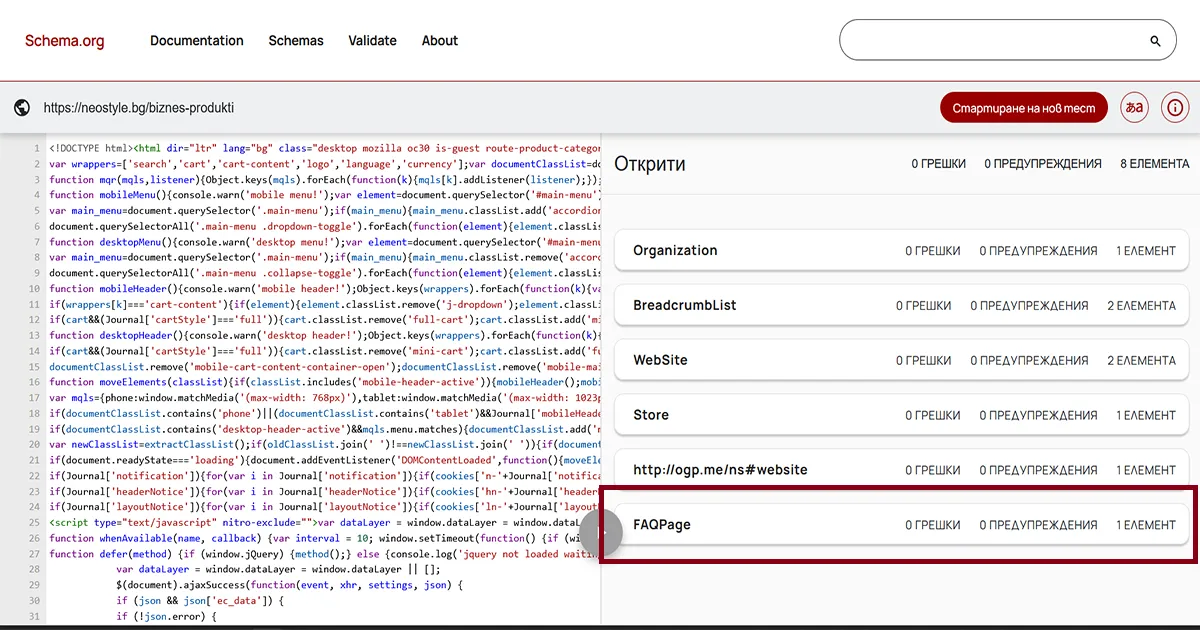
By default, OpenCart 3 does not offer a category-level FAQ section and does not generate structured FAQ data. Our paid module fills this exact gap: it adds an “FAQ” tab in the admin area, shows the questions below the category description and generates a valid FAQPage JSON-LD. The technical implementation and OCMOD code stay with us – you get a ready-to-use solution.
Category pages are often the first contact point between your customer and your store: they come from Google, from ads, from email campaigns, etc. This is where typical questions arise:
If you do not answer these questions directly on the category page:
A well-structured category-level FAQ section solves all three problems at once.
schema.org is a shared vocabulary of data types that Google, Bing and other search engines use to better understand web content (products, articles, events, FAQs, etc.).
FAQPage is a specific schema.org type describing a page that contains a
list of questions and answers.
@type: "Question".@type: "Answer".mainEntity array on the FAQPage object.This data is usually provided in a JSON-LD block in the page HTML. This is Google’s preferred format – easy to maintain and independent from the visual code.
Rich snippets are “enriched” Google search results – besides title, URL and meta description, you might see:
When Google detects a valid FAQPage JSON-LD and decides it is useful:
Important: Google never guarantees that it will show FAQ rich snippets – even if the JSON-LD is perfectly valid. But without structured data, the chance is practically zero.
Let’s describe the principle, without publishing the paid module or its code:
FAQPage object is built from the same data and
injected in a <script type="application/ld+json"> in the HTML.
This entire process is wrapped in a paid module, so the client sees only a convenient interface
and the final result in the store, without having to assemble OCMOD, Twig and PHP changes by hand.
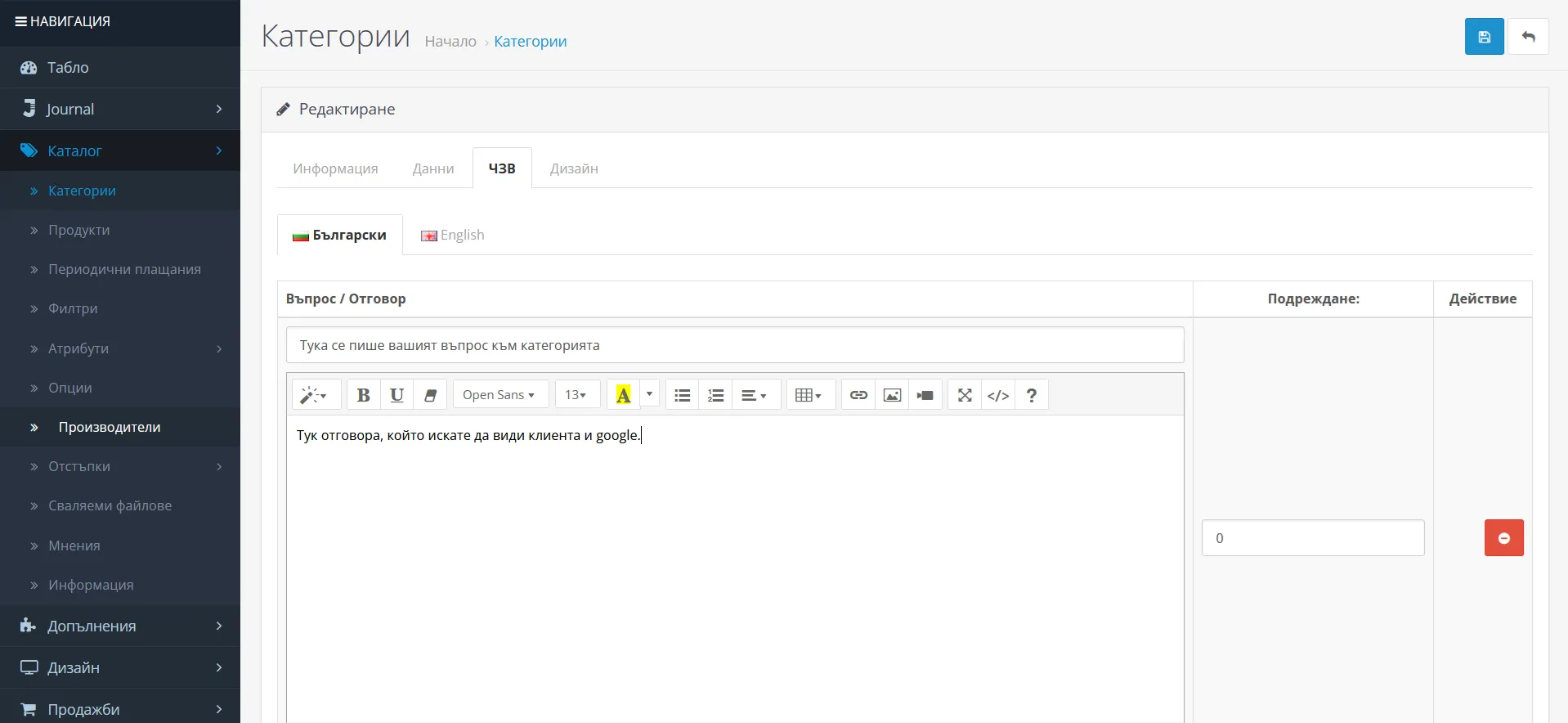
Below is a generic example of FAQPage JSON-LD. It is illustrative – it is not an excerpt from the paid module, but simply demonstrates the structure Google expects.
<script type="application/ld+json">
{
  "@context": "https://schema.org",
  "@type": "FAQPage",
  "mainEntity": [
    {
      "@type": "Question",
      "name": "What is the delivery time for products in this category?",
      "acceptedAnswer": {
        "@type": "Answer",
        "text": "Delivery takes 1–3 business days. For bulky shipments we offer palletized shipping."
      }
    },
    {
      "@type": "Question",
      "name": "Can I return the products?",
      "acceptedAnswer": {
        "@type": "Answer",
        "text": "Yes. You can return products from this category within 14 days according to legal requirements."
      }
    }
  ]
}
</script>
In our paid solution this JSON is generated automatically from the FAQs entered in the admin area – you don’t edit JSON manually and you don’t need to understand the format in detail.
Whether you use our module or another solution, the following rules always apply:
After implementing structured data (whether via our paid module or another solution) you should:
FAQPage is detected and whether there are any errors/warnings.Showing FAQ rich snippets can take time – Google needs to crawl and reindex your pages.
The implementation we use for clients is a paid module for OpenCart 3. It is not distributed as a free download – we install and configure it ourselves.
Typically, it includes:
If you wish, we can also handle the content side – writing the questions and answers for your most important categories in coordination with your SEO team.
Product, BreadcrumbList and FAQPage on one page,
but always within Google’s official guidelines.
Email us at office@ntg.bg
or request a free consultation.
We’ll discuss your specific store and give you a time and budget estimate for the implementation.
Tip: keep a document (or Git repo) with described FAQs per category, change dates and key notes. This makes future SEO audits or team changes much easier to handle.

Head of IT Infrastructure & Security at Network Technology.