
How to build a real product page for an OpenCart module with a strong focus on Journal3, clear structure for customers, FAQ blocks and properly implemented stru…
A real world example of how a product page can be convenient for customers and at the same time send the right signals to Google through Product, Breadcrumb, Merchant listings, FAQ and Organization data.
⚠ This is not SEO theory. It is a practical structure for a product page in an online store that we use in real OpenCart and Journal3 shops, so products are more visible and bring more orders.
A good product page is not just a picture and a price. It answers customer questions, creates trust, explains why this product is the right one, and at the same time sends Google structured data about the product, the breadcrumbs, the store and the FAQ block.
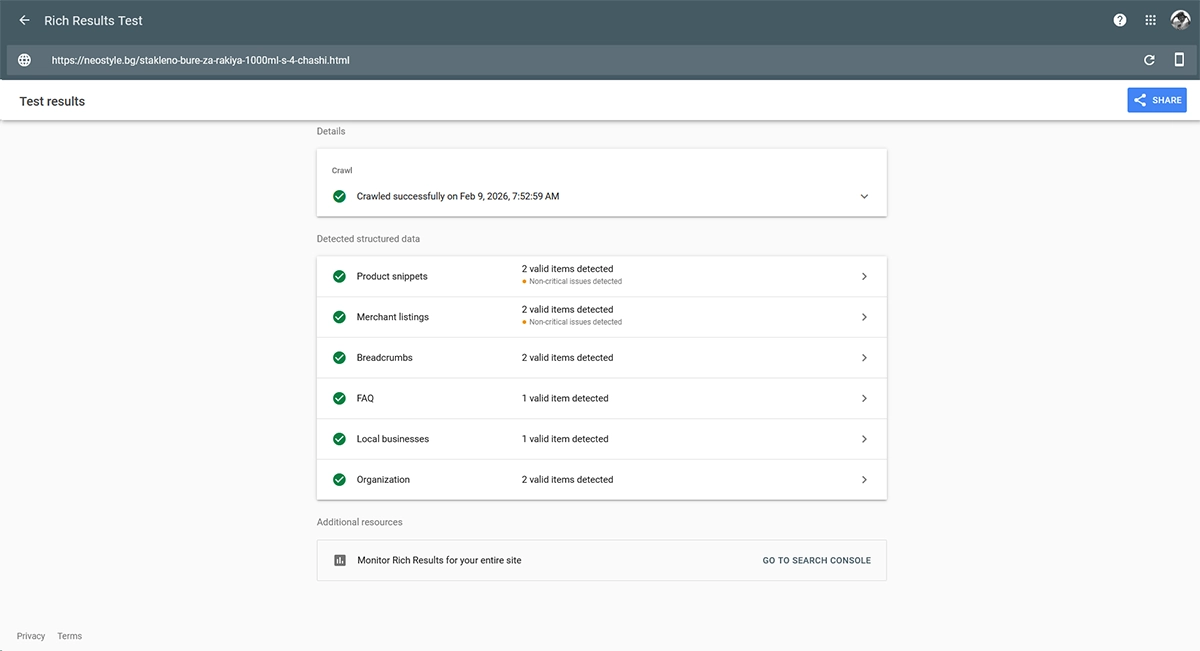
The screenshot shows a Rich Results Test for a real product page. You can see that Google detects Product, Merchant listings, Breadcrumbs, FAQ, Local business and Organization. This opens the door to richer snippets and better visibility in the results, without changing the platform.
When someone opens a product page, there are a few things they want to see immediately, without scrolling and guessing.
This means that the top of the page must be clearly organized title, gallery, short summary, price and call to action button, and below that the details and supporting blocks.
The structure below works well for most stores, whether they run OpenCart 3 with Journal3 or another theme.
When these blocks are repeated in the same way across products, the store feels structured and customers quickly learn where to find what they need.
From the search engine point of view, visual layout is not the only thing that matters. Google also looks at the structured data behind the page. In a good implementation a product page can expose several schema types at once.
When these layers are implemented correctly, you get what is visible on the screenshot at the top, the Rich Results Test detects several valid items and the page can appear in a more attractive way in the search results.
The FAQ section is not only for Google, it is first for the customer. It collects the questions that otherwise arrive by phone and email.
The same questions can be described in JSON LD as an FAQPage. This way the page helps both people and search engines, without duplicating content.
A strong product page does not require changing the platform. With OpenCart 3 and the Journal3 theme you work on top of the existing template, you arrange the blocks, add structured data, and optimise speed and JavaScript behaviour.
It is important that
If you already use OpenCart and want product pages like this, we can build on top of your current store instead of rewriting everything from scratch. You can read more about our approach in the section for OpenCart services and on the page with ready made OpenCart solutions.
We can take a real product from your catalog and rebuild its page with this logic, clear structure for the customer, structured data for Google, correct JSON LD layers and optimised loading in OpenCart and Journal3.
After that the rest of the products are aligned to the same template and the store starts to look consistent instead of “patched together”. If you want to see how this would look in your case, send us a message.
Not always, but for products that generate many questions an FAQ block helps a lot. It collects the most important answers in one place and reduces the need for extra explanations by phone and email.
A good practice is to have a short summary for people who read quickly and a longer description for those who want detail. Too little text leaves questions open, too much unstructured text pushes people away.
Yes. In most cases there is no need to change the platform. The work is done on templates, product data and structured code. The important part is to handle it carefully so existing integrations and settings are not broken.
If you work with child themes and OCMOD, it should not. The idea is to avoid editing the core of the theme and instead layer additions on top of the existing code.
Yes. No matter if the product costs five or five hundred euro, a properly structured page and correct Product and FAQ schema help the store look trustworthy and organised in search results.
This text shows how a product page in an online store can look so it helps the customer and works better in search engines. The examples are based on real OpenCart 3 stores with the Journal3 theme, but the logic can be applied to other platforms as well.

Head of IT Infrastructure & Security at Network Technology.