
Free website analysis for speed, SEO, structure and accessibility. Enter a domain or URL, see what holds you back, and get clear, actionable steps to improve.
Speed, SEO, structure, accessibility and technical signals. You see the real state of your website without guessing, and you know what to fix first.
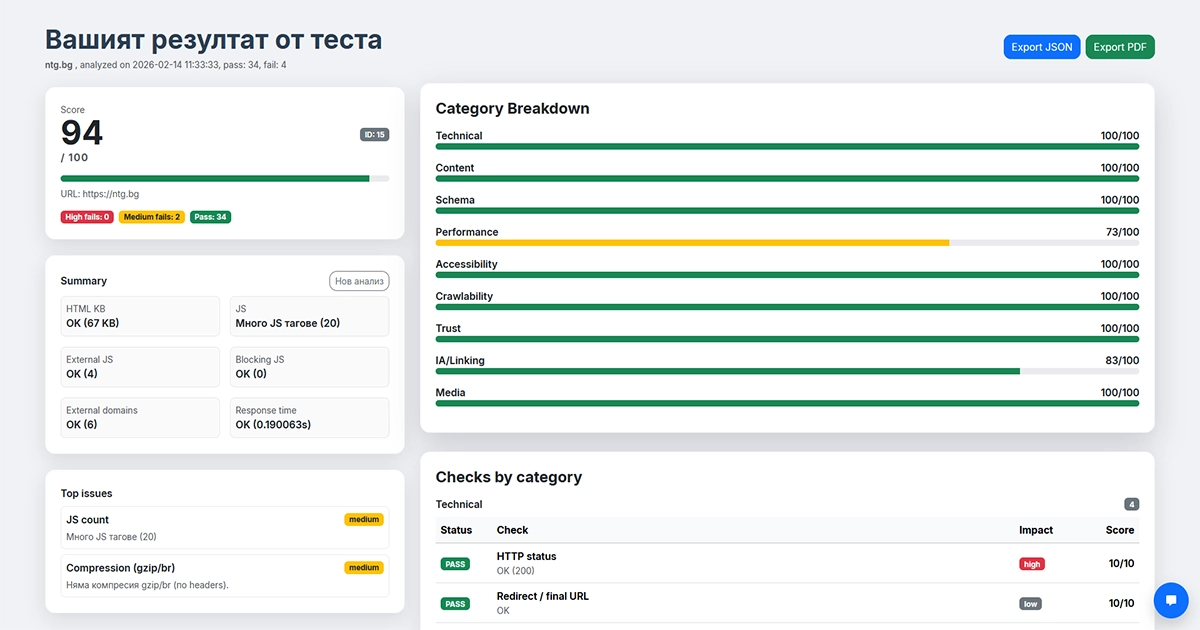
The fastest way to improve your website is to first see where it loses speed, rankings and trust, instead of spending money blindly.
Most websites look fine “at a glance”. The design is nice, the services are listed, the contact page exists. But under the hood there are often issues that users feel immediately, and Google quietly punishes. The page loads heavy, the mobile experience is not optimized, scripts block rendering, images are large and not optimized, and meta tags are left to chance.
You enter a domain or a full URL and get category scores, a list of checks and priorities. That means you do not only see “there is a problem”, you see exactly where it is and what its impact is. The report helps you start with the highest ROI fixes, not with minor details.
Start here: https://ntg.bg/en/analyzer
Owner: “The website is done, it works, why are there no inquiries?”
The issue: the website is often heavy and technically messy. The user opens it, waits, something jumps, buttons shift, images load late, and on mobile it is even worse. At that moment the person is not thinking about your service. They are thinking “this website is slow, the company is probably the same”.
And Google sees it: low engagement, quick exits, weak CTR, technical signals of low quality.
That is why the first step is analysis. Not ads. Not a new design. Analysis, then optimization.
The report is not “one score”. It is a map of problems, ordered by importance.
You save real time and money because you work on the right things, not on assumptions.
After the analysis, the questions that should have been solved earlier almost always appear. They sound simple, but the impact is huge:
The truth is simple. A website becomes competitive when it is fast, well structured and technically clean. That happens step by step, and it starts with a clear report.
This is the area that directly affects your visibility in search and whether people will click your result. It is not enough to have “some text”. You need the right signals that clearly tell Google what the page is about and why it is useful.
The analysis checks key elements such as titles, meta description, H1 structure and consistency between them. When those elements are messy, two painful things often happen. First, Google may show something different than you intended, and CTR drops. Second, the page may rank worse because the signals are diluted.
Examples we see constantly:
When this is done properly, the effect is direct, better clarity for Google, a clearer message for the user, and a higher chance of clicks and inquiries.
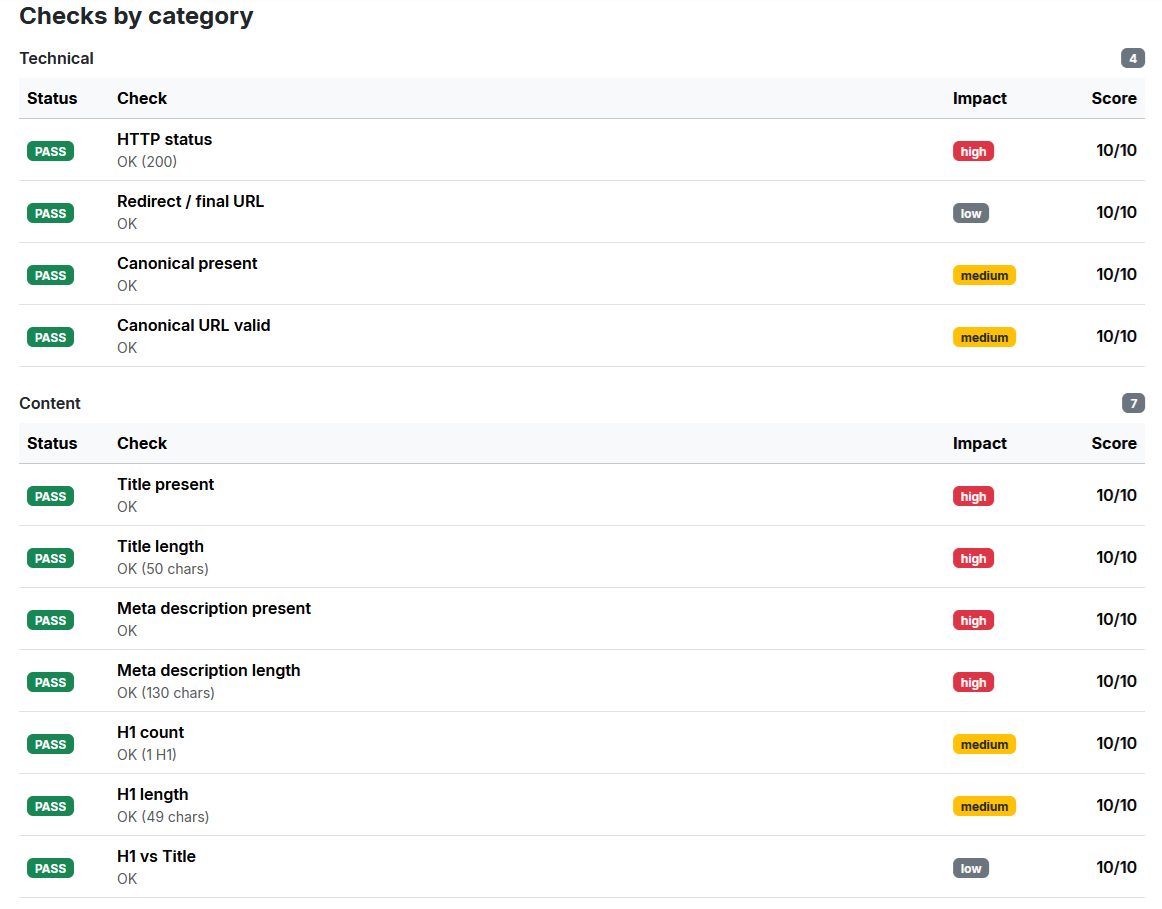
This is where technical advantage happens. Many websites have content, but lose because they are slow, heavy, and do not provide the right structured signals. Schema helps search engines understand what type of content you have, service, organization, article, FAQ, product, review, and more.
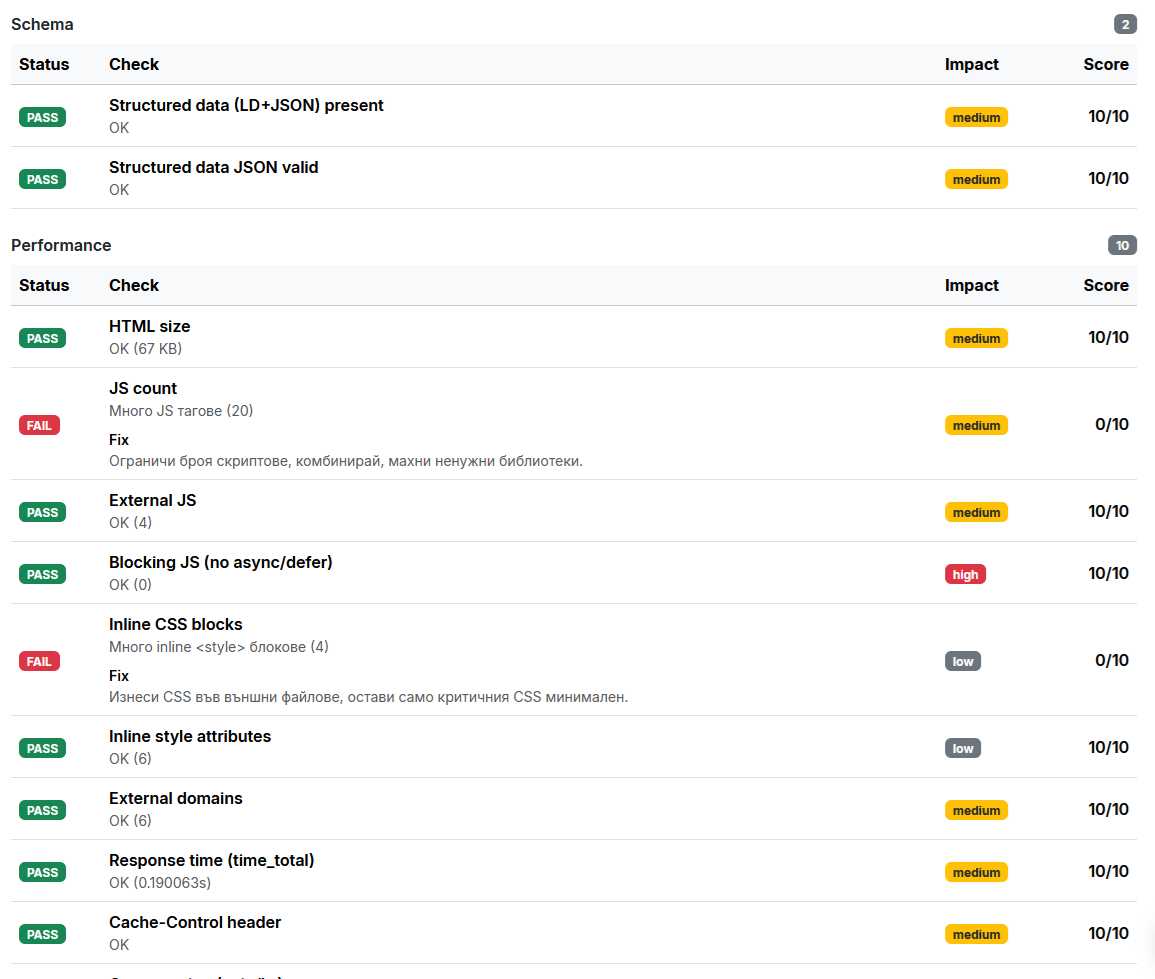
Performance is what users feel immediately. If the page opens slowly, if there is a delay before the first meaningful content, if too much JavaScript runs before anything useful is visible, people leave. Google sees it and it affects rankings. This is not theory. This is daily reality.
Typical issues here include:
These are “invisible” problems, but the effect is visible. The site does not feel fast and does not look trustworthy. If the goal is to become top tier, this area has serious potential.
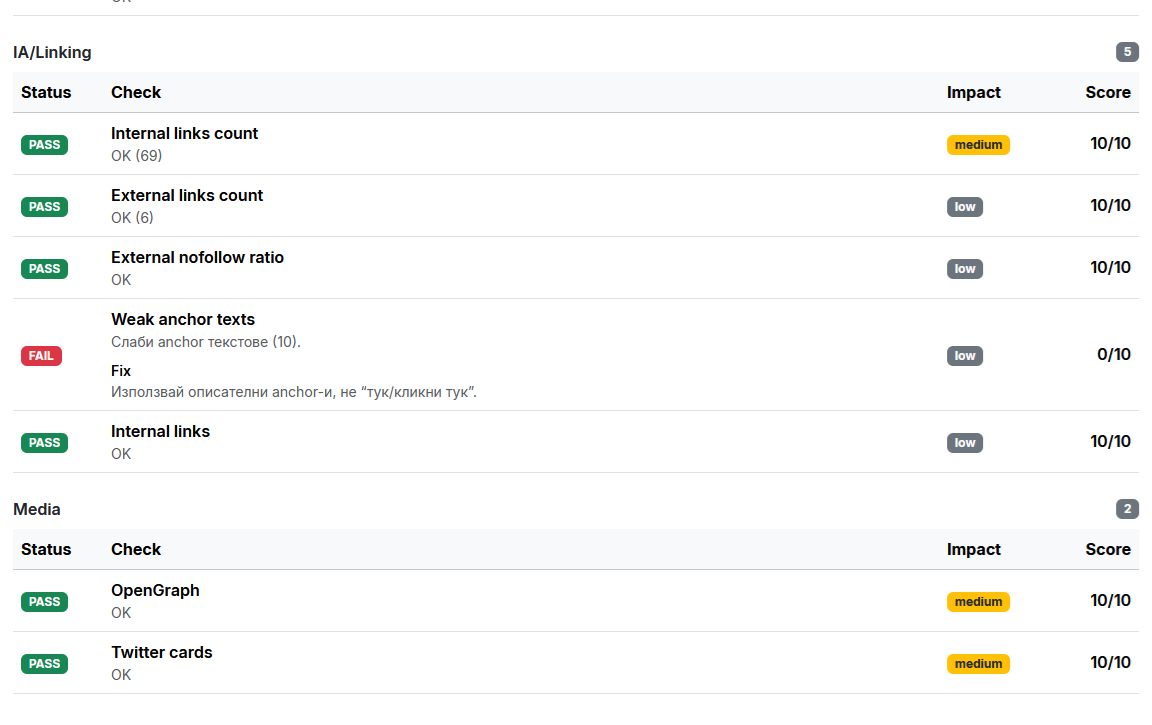
IA means information architecture, the way the website is structured so both users and search engines can navigate it easily. You can have great content, but if pages are buried, internal links are missing, and navigation does not lead to important pages, the impact gets lost.
Linking is critical. Internal links show which pages matter, help crawling and distribute authority. Without a clear logic, Google may index odd pages and miss the important ones.
Media is the other big pain. Many websites are heavy because they use huge images without compression, without correct sizing, and without proper lazy loading where needed. The result is simple math: more megabytes, more time, less patience.
The analysis can reveal issues such as:
When this is organized properly, the site becomes easier to use, faster, and clearer for search engines. This is a difference people can feel.
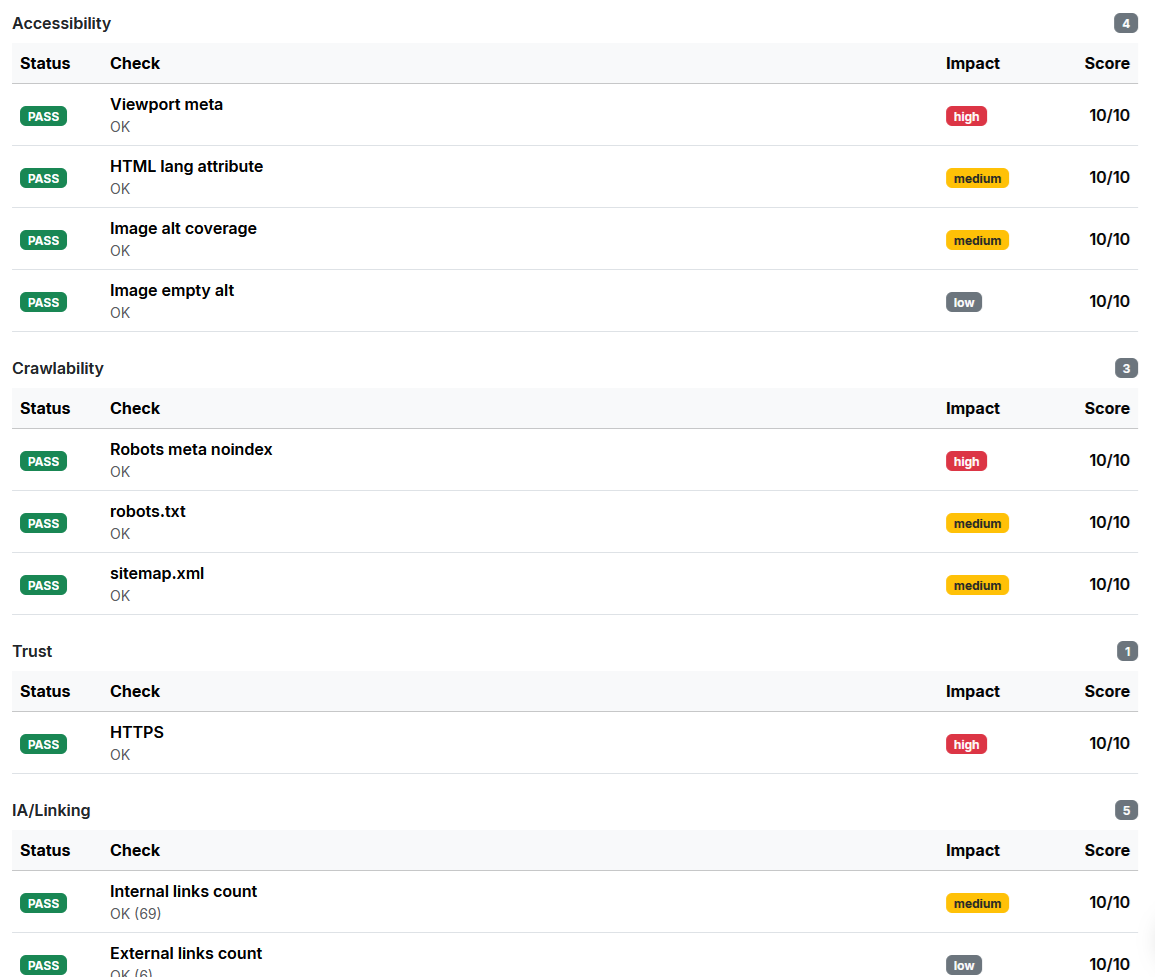
Accessibility is not an “extra”. It is part of quality. When a website has clear alt attributes, correct page language, reasonable contrast, and elements that are easy to use, it feels professional. And a professional feel equals trust.
This also includes basic technical settings that are often skipped: viewport for mobile devices, correct image attributes, and basic ARIA elements where they make sense. Even if your goal is not a “perfect accessibility score”, these things impact UX and how search engines interpret the page.
Examples of what can show up here:
These are details, but details are the difference between “a website exists” and “a professional website”.
The analysis is the first step. Then comes the real work, optimization, structure, configuration, and removing unnecessary weight. If the report shows that the site is loaded by too much JavaScript, missing compression, misconfigured caching, or chaotic structure, we can implement the improvements.
We work pragmatically. First we fix the highest impact areas: speed, technical signals, structure, and only then the smaller details. The goal is not just “a better test score”. The goal is a website that feels faster, clearer, and more trustworthy.
Start the analysis and if you want to turn the report into real improvements, use the analyzer: https://ntg.bg/en/analyzer
Yes. Enter a domain or a URL and you get a report with category scores and concrete checks. This gives you a clear direction on what to fix first, instead of guessing.
You will see category scores for content and SEO signals, performance, structure and accessibility. You will also see what passes and what does not, plus priorities so you can work step by step.
Yes. If you need real optimization, we can work on speed, compression, caching, reducing unnecessary JavaScript, image optimization, improving structure and core SEO signals. The goal is real impact, not just “a report”.
It depends on the current state and how many things you want to address at once. In many cases there are quick wins with immediate impact, such as compression, caching and optimizing heavy resources. Bigger changes such as structure refactoring and script cleanup depend on the specific website.
No serious professional can guarantee rankings, because it depends on competition, niche, content and many other factors. But a technically clean, fast and well structured website almost always has a real advantage over heavy and chaotic websites. The goal is to remove technical brakes and give your content and services a real chance to perform.
This article is written by Eng. Svilen Arsov, Head of IT Infrastructure and Security at Network Technology.