A new domain at -90% off? Why "a business in a week" is a myth
A cheap new domain is not a business. Google does not rank by domain price, but by trust built over months — here is why a "fast scheme" is impossible.
A new domain isn't a business — it's an empty address plate.
Registering it takes 2 minutes. Earning Google's trust takes months, no matter how cheap the domain was.
A new domain at -90% off? Why "a business in a week" is a myth
The ads are everywhere: buy a heavily discounted domain, slap a site on it, and boom — a business. The
problem isn't the domain's price. The problem is that Google doesn't know the site yet and has no
reason to trust it from day one.
Here's what actually happens with a new domain in Google — not guesswork, but observed indexing and
ranking behavior we see every day in our own SEO audit work.
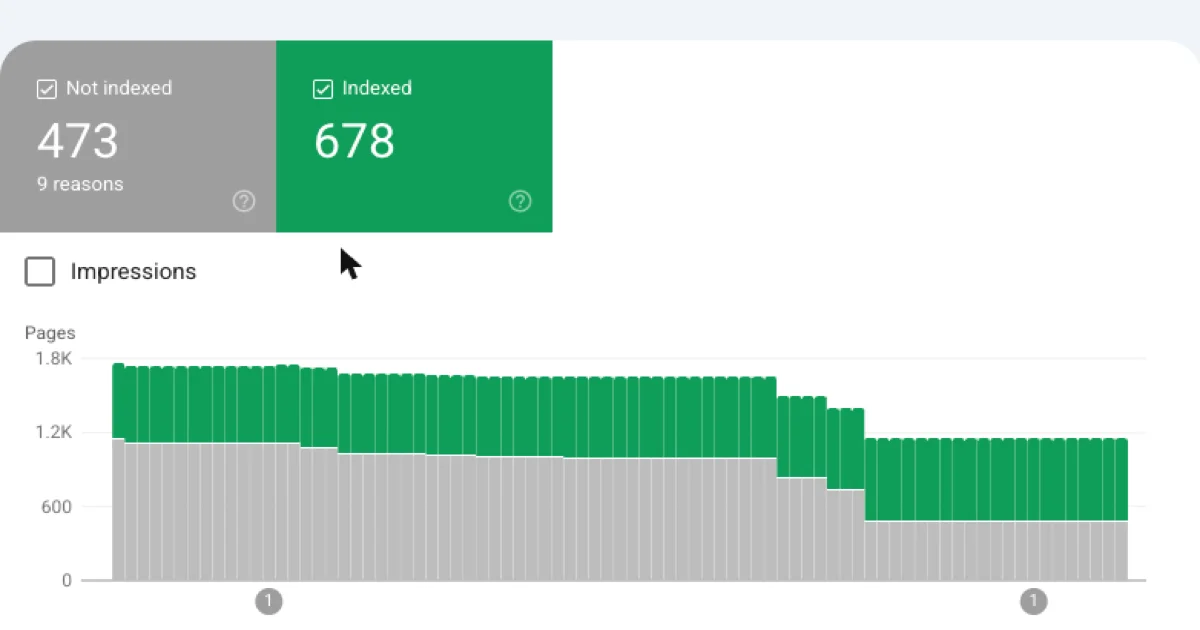
Real Google Search Console data — indexing grows gradually over months, not days. This is an established
site with history; on a brand-new domain the curve starts from literally zero.
Google doesn't rank domains because of their price or registration date. It ranks them because of
trust — built through content, links from other sites, real visitor behavior, and time.
A cheap domain isn't the problem by itself — the problem is the expectation that registering a domain is
the same as having a working business. Those are two completely different things.
Below are six things domain sellers pushing "-90% off" and "ready-made business" packages usually leave out.
6 things a cheap domain ad won't tell you
1
Zero history, zero trust
Google doesn't "recognize" a new domain as good or bad — it simply has no signals about it at
all. No past behavior, no accumulated links, nothing to base a judgment on.
Older, established sites start from a position of trust. A new domain starts from zero, regardless of its price.
2
Indexing takes days to weeks
Launching a site doesn't mean it's in Google right away. Discovering, crawling and
indexing new pages takes real time — even on a technically flawless site.
On a larger or more competitive site, full indexing can take months, not days.
3
Zero links from other sites
Links from real, relevant sites are one of the strongest trust signals. A brand-new domain starts with
exactly zero of them.
Building them legitimately takes time and genuinely useful content — it doesn't come bundled with the domain.
4
Competitive niches don't forgive
In a niche with dozens of established players, a new site competes with domains that have spent years
building content, links and reputation. A domain discount doesn't shrink that gap.
In a narrower, less competitive niche things move faster — but "faster" still means months, not days.
5
A domain doesn't replace content
Registration gives you an address, not a business. You need real pages that are
genuinely useful to the people searching for them — not boilerplate text copied from somewhere else.
Google notices thin, duplicated or pointless content — and that slows things down further, not faster.
6
Local trust is built separately
For a local business, ranking in the map and local results depends on a Google Business Profile with
real reviews — not on the site and domain alone.
A profile with no history and no reviews loses out to competitors with real reputation, even if their site is weaker.
What actually takes time
A realistic path for a new site includes:
A technically sound site — fast, mobile-friendly, properly structured
Genuinely useful content, written for the specific people searching for it
Gradual link-building from relevant sources
A Google Business Profile with real reviews, for local businesses
Consistency over months, not a one-time "setup"
Realistic timeline
Indexing: days – weeks
First real rankings: months
Competitive niche: 6–12+ months
approximate — depends on the niche, competition and consistency of the work
Will AI recommend you?
The same applies to ChatGPT, Gemini, Copilot and Google's own AI answers (AI Overview, AI Mode). These systems
don't invent recommendations out of thin air — they pull answers from sources with an established
history: indexed content, citations, real reviews, structured data. The exact same signals described above.
A brand-new domain with none of that history has nothing for an AI system to cite — it simply
has no basis to recommend it over an established competitor. The "AI era" doesn't open a back door for
a fast business; it relies on the same trust that classic SEO has always required.
Frequently asked questions
No. A domain's price and registration date aren't a ranking signal in Google.
Rankings depend on content, links, the site's technical state and time — none of which a discount changes.
Not because of the price alone. The issue is the marketing promise of "a ready business in a
week" — it's misleading because it skips the real work on content, technical SEO and trust,
which takes months.
It can help somewhat if its history is clean and relevant, but it also carries risk — if the domain
was penalized or linked to spam, it inherits that problem. It's not a guarantee and doesn't
replace real work on the site.
Indexing a new site usually takes days to weeks. First real, visible rankings — months. In a
competitive niche — between 6 and over 12 months of consistent work. There's no shortcut around this.
Want a real growth plan for Google, not a "-90% domain" illusion?
An SEO audit of your current site or a new project, a realistic plan with timelines, and an honest assessment
of what's achievable in your niche — no promises that don't hold up.